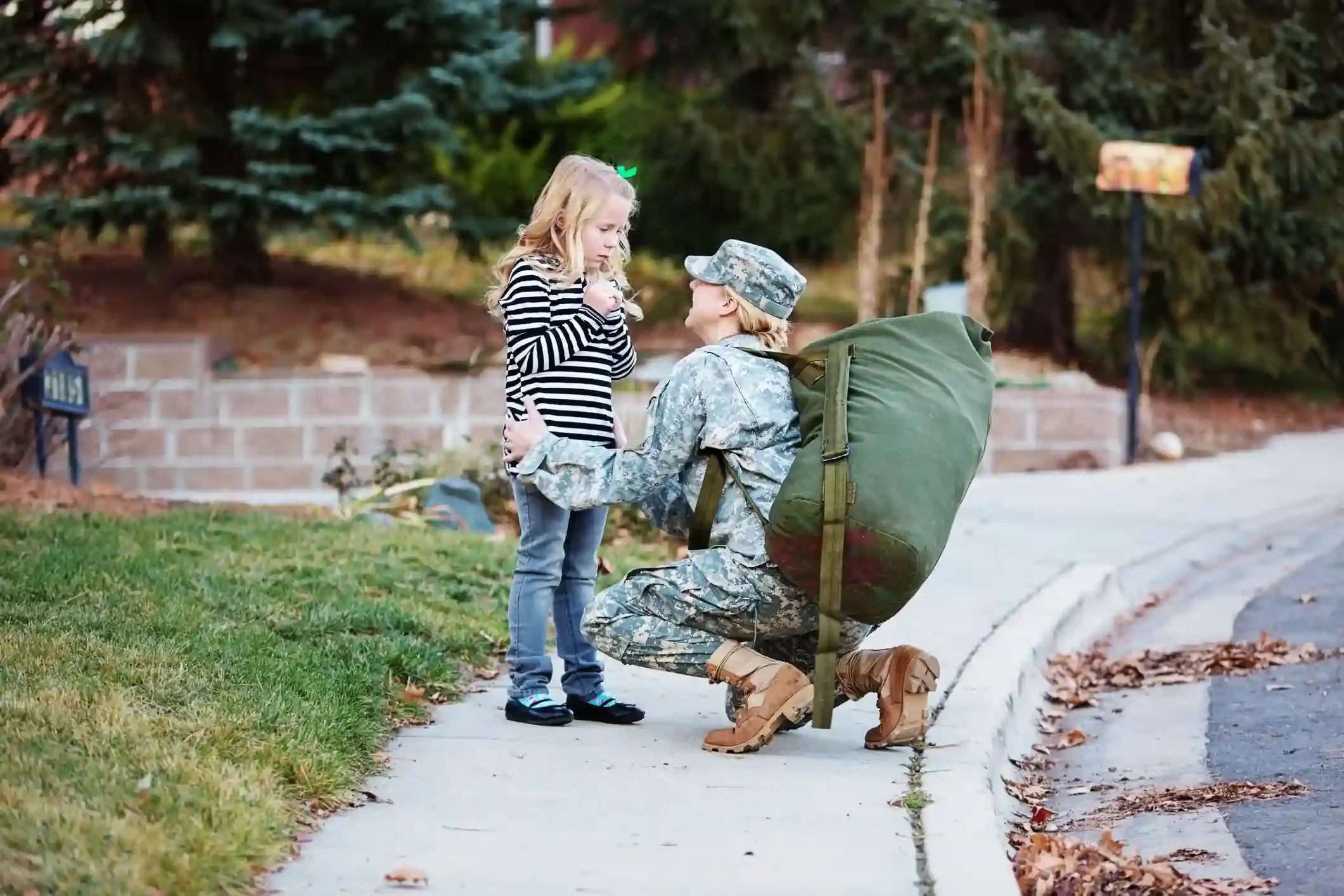
Military Family Time-Sharing in Florida When a Parent Is Deployed
We Know How to Help When a Servicemember Deploys
Military servicemembers make great sacrifices to serve their countries. So, military families do not have ordinary parenting schedules. Orders change. Training changes. Deployment dates move. Leave may appear with very little notice. A parent may be sent across the country or across the world while a child remains in Florida.
That creates hard questions:
What happens when a servicemember is unavailable because duty calls?
Who exercises time-sharing while the military parent is deployed?
Can a grandparent, stepparent, relative, or trusted adult step in temporarily?
Can the non-deployed parent object?
Does deployment justify a permanent change to the parenting plan?
What happens to child support while the child is living primarily with one parent or a temporary caregiver?
Can the deployed parent testify by phone or video?
What happens when the deployed parent returns?
Florida has a specific statutory framework for these issues. Many people still refer to the old statute, Florida Statute 61.13002, which dealt with temporary time-sharing modification and child support modification due to military service. That statute was repealed and replaced by Florida’s Uniform Deployed Parents Custody and Visitation Act, which is now found in Florida Statutes sections 61.703 through 61.773.
The law is technical. The facts matter. The orders matter. The wording of the proposed temporary order matters. A sloppy agreement can create chaos. A smart agreement can protect the child, preserve the parent-child bond, and prevent a temporary deployment issue from becoming a permanent custody war.
At Mockler Leiner Law, P.A., we represent servicemembers and military spouses in military divorce, paternity, custody, time-sharing, relocation, child support, and post-judgment cases. We understand Florida family law, federal military issues, deployment realities, and the courtroom pressure that comes with a parent leaving on orders.
Florida Military Time-Sharing Law: The Big Picture
Florida’s deployed-parent statute is designed to solve a practical problem: a servicemember’s military orders may temporarily interfere with that parent’s ability to exercise time-sharing, but deployment alone should not be treated as parental abandonment, lack of involvement, or a reason to permanently strip a parent of rights.
The law recognizes several core principles:
A deployment-related time-sharing arrangement is usually temporary.
A deploying parent may need a plan for the child during deployment.
The other parent’s rights still matter.
A nonparent may receive temporary caretaking authority in the right case.
The child’s best interests remain central.
A temporary arrangement does not automatically create permanent rights for a grandparent, stepparent, relative, or other nonparent.
A permanent change of station is different from deployment and is generally handled under Florida’s relocation statute.
Child support may need to be temporarily addressed if the child’s living arrangement changes during deployment.
The returning parent should have a clear path back into the child’s life when deployment ends.
This is not a “fill in the blank” issue. The court needs a precise plan.
What Counts as “Deployment” Under Florida Law?
Florida’s current deployed-parent statute defines deployment as a movement or mobilization of a servicemember for less than 18 months under uniformed service orders when the orders:
Are designated as unaccompanied;
Do not authorize dependent travel; or
Otherwise do not permit family members to move to the location where the servicemember is deployed.
This matters because not every military move qualifies. Temporary duty, deployment, activation, overseas assignment, mobilization, and permanent change of station are not always the same thing.
A parent cannot simply say, “I am in the military, so I get deployment protection.” The court needs to know:
What the orders say;
Where the servicemember is going;
How long the assignment is expected to last;
Whether dependents may travel;
Whether the child can realistically accompany the parent;
Whether the assignment is temporary deployment or a permanent change of station;
Whether the orders materially affect the existing parenting plan.
The distinction is critical. A permanent change of station is generally governed by Florida’s relocation statute, not the deployed-parent custody statute.
Old Florida Statute 61.13002 and Why It Still Matters
Many lawyers, parents, and search engines still refer to Florida Statute 61.13002. That statute used to cover temporary time-sharing modification and child support modification due to military service.
Under the old statute, a military parent could sometimes designate a family member, stepparent, or relative by marriage to exercise time-sharing during certain military assignments. The statute also addressed temporary child support, electronic contact, liberal time-sharing during leave, and reinstatement of the prior time-sharing order when the servicemember returned.
But section 61.13002 is no longer the current law. Florida replaced it with a more detailed statute: the Uniform Deployed Parents Custody and Visitation Act.
For SEO purposes, this page discusses “delegation of time-sharing under Florida Statute 61.13002” because that is the phrase many people still use. Legally, however, the current analysis should be under Florida Statutes sections 61.703 through 61.773.
Florida’s Current Law: Uniform Deployed Parents Custody and Visitation Act
Florida’s current law uses several important terms.
Custodial Responsibility
“Custodial responsibility” includes the powers and duties relating to a child. It includes:
Physical custody;
Legal custody;
Parental responsibility;
Parenting time;
Time-sharing;
Visitation;
Decision-making authority;
Authority to grant limited contact with the child.
This is broader than simply asking, “Who has the child on Friday night?” It includes daily care, important decisions, contact, logistics, and temporary authority.
Caretaking Authority
“Caretaking authority” means the right to live with and care for a child on a day-to-day basis. In ordinary Florida family law language, this is similar to physical time-sharing or parenting time.
Decision-Making Authority
Decision-making authority means the power to make important decisions for a child, including decisions about:
Education;
Health care;
Religious training;
Extracurricular activities;
Travel.
A military deployment order should be very specific if decision-making authority is being shared, limited, delegated, or temporarily assigned. A vague order creates conflict.
Limited Contact
Limited contact means authority given to a nonparent to visit with the child for a limited time. It can include authority to take the child somewhere other than the child’s residence.
This is different from full caretaking authority. A grandparent might receive limited contact without receiving the right to exercise the deploying parent’s entire time-sharing schedule.
Notice Required From the Deploying Parent
A deploying parent generally must notify the other parent in a record of the pending deployment within 7 days after receiving notice of deployment, unless military circumstances reasonably prevent that notice. If the parent cannot provide notice within 7 days, the parent must provide notice as soon as reasonably possible.
The deploying parent must also provide a proposed plan for how each parent’s share of custodial responsibility will be handled during deployment.
This should not be casual. The notice and proposed plan should be organized, documented, and ready for court.
A strong proposed deployment plan may address:
The deployment start date;
The expected return date;
Any operational security limitations;
The proposed temporary time-sharing schedule;
Whether the child will remain with the other parent;
Whether a nonparent will receive caretaking authority;
The identity and background of any proposed nonparent;
Transportation arrangements;
School and activity logistics;
Medical decision-making;
Communication between the deployed parent and child;
Leave contact;
Child support;
Health insurance;
DEERS and TRICARE enrollment;
Termination of the temporary arrangement after return.
When a deploying parent gives no meaningful plan, the other parent may have a much stronger argument that the proposed arrangement is not workable or not in the child’s best interests.
Can a Military Parent Delegate Time-Sharing During Deployment?
Yes, but the current statute is more precise than the old “delegation” language.
A court may grant temporary caretaking authority to a nonparent if the deploying parent files a motion and the arrangement is in the child’s best interests.
The nonparent may be:
An adult family member of the child; or
An adult who is not a family member but has a close and substantial relationship with the child.
If the proposed nonparent is not a family member, the best-interest showing must be established by clear and convincing evidence.
That is a higher evidentiary standard. The deploying parent should be ready to prove the relationship, not just assert it.
Who Can Serve as the Temporary Caregiver?
Depending on the facts, a proposed temporary caregiver may include:
A grandparent;
A stepparent;
An adult sibling;
An aunt or uncle;
A cousin;
Another adult family member;
A trusted non-family adult with a close and substantial relationship with the child.
The court should look carefully at the child’s actual relationship with the proposed caregiver.
Relevant evidence may include:
How long the child has known the person;
Whether the person has cared for the child before;
Whether the child has overnight history with the person;
Whether the person understands the child’s school, medical, emotional, and activity needs;
Whether the person can support the child’s relationship with both parents;
Whether the proposed arrangement creates stability or conflict;
Whether the nonparent has any criminal, substance abuse, mental health, domestic violence, or safety issues;
Whether the plan is a true temporary support system or an attempt to sideline the other parent.
The statute does not allow a military parent to casually hand off a child to someone else just because deployment is inconvenient. The court should expect proof.
The Other Parent’s Rights Still Matter
The non-deployed parent is not erased by the servicemember’s deployment.
If the other parent already has custodial responsibility, the court must consider that parent’s rights, role, relationship, and ability to care for the child. Deployment does not automatically mean the military parent’s relatives step into the military parent’s shoes.
This is one of the most important battlegrounds in these cases.
A deploying parent may argue:
The child has a strong relationship with the proposed caregiver;
The child should maintain connection with the deployed parent’s side of the family;
The proposed caregiver has historically assisted with the child;
The arrangement protects the parent-child bond during deployment;
The other parent should not receive a windfall of 100% time-sharing because of military orders.
The other parent may argue:
The child should remain primarily with a parent, not a nonparent;
The proposed caregiver does not have a close and substantial relationship with the child;
The plan exceeds the deploying parent’s prior time-sharing;
The proposed caregiver cannot meet the child’s needs;
The proposed arrangement creates unnecessary conflict;
The request is not truly temporary;
The deploying parent is attempting to use deployment to control the child through a third party.
The court’s job is not to punish the servicemember. The court’s job is also not to ignore the other parent. The court must make a temporary order that fits the statute, protects the child, and respects the actual parenting structure.
How Much Time Can Be Granted to a Nonparent?
Unless the other parent agrees, the temporary caretaking authority granted to a nonparent generally may not exceed the amount of time the deploying parent had under the permanent custody order.
If there is no permanent custody order, the nonparent’s temporary authority generally may not exceed the amount of time the deploying parent habitually cared for the child before receiving notice of deployment.
The court may add travel time necessary to transport the child.
This limitation is important. A deployment order should not be used to expand the deploying parent’s side of the schedule beyond what the deploying parent actually had.
For example:
If the deploying parent had alternating weekends, a nonparent usually should not receive a 50/50 schedule unless the other parent agrees or another legal basis exists.
If the deploying parent had no overnights, the nonparent should not automatically receive overnights.
If the deploying parent was exercising more time by informal agreement than the written order provides, evidence of the actual historical care may become important.
If there is no prior order, the court may need evidence of the child’s real schedule before deployment notice.
This is where trial preparation matters. The calendar, text messages, school pickup records, travel records, photographs, medical forms, and witness testimony may matter.
Temporary Decision-Making Authority During Deployment
Deployment can interfere with decision-making, especially if the parent is in a location where communication is limited or delayed.
Florida law allows the court, in appropriate circumstances, to grant part of the deploying parent’s decision-making authority to a nonparent if:
Operational constraints of the deployment prevent the deploying parent from exercising decision-making authority;
The temporary grant is in the child’s best interests;
The authority is narrowly drawn to the child’s reasonably foreseeable needs;
The order considers the role of the other parent;
The order specifies the decision-making powers granted;
The duration does not exceed the time the deploying parent is unable to exercise the authority.
This is not a license to create a third parent.
A careful order should identify exactly what authority is being granted. For example:
Authority to take the child to routine medical appointments;
Authority to communicate with school personnel;
Authority to sign activity forms;
Authority to transport the child;
Authority to handle emergency decisions if the deploying parent cannot be reached;
Authority to access medical or school records, if appropriate.
The order should also state what the nonparent cannot do.
For example, the order may prohibit the nonparent from:
Changing the child’s school;
Authorizing major non-emergency medical treatment without parental consent or court order;
Removing the child from Florida without written consent or court order;
Interfering with the other parent’s rights;
Blocking communication between the child and either parent;
Using the temporary authority after the deploying parent returns.
The more precise the order, the fewer fights later.
Limited Contact for Grandparents, Stepparents, Relatives, and Other Adults
Florida law also allows limited contact between a child and a nonparent during deployment.
A court shall grant limited contact to a nonparent who is a family member of the child, or to a non-family adult with a close and substantial relationship with the child, on motion of a deploying parent unless the court finds that the contact is not in the child’s best interests.
For a non-family adult, the best-interest showing must be established by clear and convincing evidence.
Limited contact may be appropriate when full caretaking authority is too much. For example, a court may allow:
One weekend per month with grandparents;
Dinner visits with a stepparent;
Video calls with extended family;
Contact during school breaks;
Attendance at activities;
Transportation to visits with the deployed parent during leave.
A parent opposing limited contact should be ready to explain why the contact is not in the child’s best interests, not merely why the parent dislikes the proposed person.
Written Agreements During Deployment
Parents can enter into a temporary agreement granting custodial responsibility during deployment.
The agreement must be in writing and signed by both parents and any agreed-upon nonparent who will receive custodial responsibility.
A strong temporary deployment agreement should address:
The destination, duration, and conditions of deployment, to the extent permitted;
The allocation of caretaking authority;
The allocation of decision-making authority;
Any limited contact granted to a nonparent;
A process to resolve disputes;
The frequency, duration, and method of communication between the deployed parent and the child;
The role of each parent or nonparent in facilitating communication;
Who pays communication costs;
Contact during leave;
Transportation;
School logistics;
Medical care;
Travel restrictions;
Child support;
Health insurance;
DEERS/TRICARE enrollment;
How and when the agreement terminates;
Which parent must file the agreement with the court, if filing is required.
A deployment agreement does not automatically modify child support. If child support needs to change, the parties should address that issue through the proper court process.
Filing the Agreement or Power of Attorney With the Court
If a court has already entered an order relating to custodial responsibility or child support, a deployment agreement or power of attorney must be filed within a reasonable time with the court that entered the existing order.
The filing should include the case number and heading of the pending case.
This matters because a private side agreement may not be enough. If the existing court order says one thing and the deployment agreement says another, enforcement can become messy unless the court file is handled correctly.
Military Family Care Plans Are Not Enough
A military family care plan may be required by the servicemember’s branch of service. It may be very important inside the military system.
But a family care plan is not the same thing as a Florida court order.
A family care plan may identify who will care for a child during deployment. That does not necessarily mean the person automatically receives enforceable Florida time-sharing rights over the objection of the other parent.
If there is a Florida parenting plan, paternity order, divorce decree, child support order, or pending custody case, the family care plan should be coordinated with Florida law.
Power of Attorney During Deployment
A deploying parent may use a power of attorney to grant all or part of custodial responsibility to an adult nonparent during deployment only in specific circumstances.
This may be available if:
No other parent possesses custodial responsibility; or
A current court order prohibits contact between the child and the other parent.
The deploying parent may revoke the power of attorney by signing a revocation.
A power of attorney can be useful, but it should not be misused. It may help with school, medical, travel, and daily-care logistics, but it does not necessarily override the rights of the other parent or the authority of an existing Florida court order.
Temporary Court Orders During Deployment
After a deploying parent receives notice of deployment and until deployment terminates, a court may issue a temporary order granting custodial responsibility, unless the Servicemembers Civil Relief Act prevents the proceeding.
A court may not issue a permanent order granting custodial responsibility without the consent of the deploying parent.
This is a major protection. Deployment should not become a backdoor permanent modification.
Either parent may file a motion regarding custodial responsibility during deployment. If a motion is filed before the deploying parent deploys, the court must conduct an expedited hearing.
The motion should be specific. A good motion should tell the court:
What the current parenting plan provides;
What the deployment orders require;
How the orders interfere with the current schedule;
What temporary arrangement is requested;
Whether a nonparent is proposed;
Why the proposal is in the child’s best interests;
How communication will occur;
How leave will be handled;
Whether child support should temporarily change;
How the arrangement will terminate after deployment.
Electronic Testimony for Deployed Parents and Military Witnesses
Florida law allows a deploying parent or servicemember witness who cannot reasonably appear in person to appear, testify, and present evidence by telephone, electronic means, or web-based means in a temporary custody proceeding.
This can be critical when a parent is already deployed, training, stationed away from Florida, or unable to travel because of military duties.
But electronic testimony still needs planning.
The lawyer should address:
Oath administration;
Exhibits;
Time zone differences;
Secure connection;
Witness availability;
Operational limitations;
Backup phone access;
Whether testimony may reveal protected military information;
How to handle cross-examination.
A deployed parent should not lose a hearing simply because the parent is serving. But the parent also needs to be ready to present evidence in a way the court can use.
The Servicemembers Civil Relief Act and Florida Time-Sharing Cases
The Servicemembers Civil Relief Act can affect family law litigation when military service materially impacts a servicemember’s ability to appear, defend, or participate.
In deployment-related parenting cases, the SCRA may intersect with Florida’s deployed-parent statute. The court may be able to make temporary arrangements, but the servicemember may have rights if military duties prevent meaningful participation.
The key is not delay for the sake of delay. The key is fairness, notice, evidence, and a workable plan for the child.
What Must Be Included in a Temporary Custody Order?
A Florida temporary custody order during deployment should be detailed.
When applicable, the order must:
Designate the order as temporary;
Provide for termination after the deploying parent returns;
Identify the destination, duration, and conditions of deployment to the extent permissible;
Specify the allocation of caretaking authority, decision-making authority, and limited contact;
Provide a process to resolve disputes;
Provide for liberal communication between the deployed parent and the child during deployment, including electronic communication, unless that is not in the child’s best interests;
Allocate communication costs;
Provide for liberal contact between the deployed parent and child during leave or other availability, unless that is not in the child’s best interests;
Provide for reasonable contact after return from deployment until the temporary order terminates, even if that contact exceeds the deployed parent’s pre-order time.
That last point is important. A returning parent may need temporary reintegration time before the old order fully resumes or before the temporary order terminates. The child may need structure. The parent may need transition time. The other parent may need clear rules.
Child Support During Deployment
Deployment can change the financial picture.
Florida law allows the court to enter temporary child support orders when a court has issued an order granting caretaking authority or when an agreement granting caretaking authority has been executed.
The court may:
Enter temporary child support from the deploying parent to the other parent under Florida Statute 61.30;
Require the deploying parent to enroll the child as a military dependent with DEERS, TRICARE, or similar military dependent benefits;
Suspend, abate, or reduce the child support obligation of the other parent until the prior custody judgment or time-sharing order is reinstated.
This is one of the most commonly mishandled parts of deployment time-sharing.
Child support should not be guessed. Military income may include basic pay, BAH, BAS, special pays, bonuses, allowances, combat pay, tax-free benefits, and other items that need careful review. The court may also need to understand how deployment changes income.
For more on military pay and support calculations, see our page on calculating military income and our page on military family support.
DEERS and TRICARE Issues
A deployment order should not ignore health benefits.
The court may require the deploying parent to enroll the child as a military dependent with DEERS, TRICARE, or other available military dependent benefits.
This can matter in cases involving:
Medical insurance;
Dental coverage;
Therapy;
Prescription medication;
Special needs;
Out-of-state care;
Military base access;
Identification cards;
Coordination between civilian and military providers.
A parent should not wait until a child needs care to discover that enrollment was never completed.
Deployment Is Temporary. The Parenting Plan Should Not Be Permanently Rewritten by Ambush.
One of the most important principles in deployment cases is that the arrangement is temporary.
A grant of temporary authority does not create an independent, continuing right to caretaking authority, decision-making authority, or limited contact for the nonparent.
That means a grandparent, stepparent, relative, or family friend does not become a permanent time-sharing party simply because the person helped during deployment.
The temporary authority exists because deployment created a temporary need. When that need ends, the temporary authority should end unless another legal basis exists.
Can the Court Consider Military Service Against a Parent?
Florida law provides that, in a proceeding for custodial responsibility involving a child of a servicemember, the court may not consider a parent’s past deployment or possible future deployment in determining the child’s best interests.
That is a powerful protection.
A parent should not be punished for serving. A parent should not lose custody because the parent may deploy again someday.
However, the court can still consider the actual facts affecting the child. The court can address the schedule, logistics, communication, school stability, child care, transportation, and the child’s needs. The court just cannot treat military service itself as a negative character trait.
Permanent Change of Station Is Different
Florida’s deployed-parent statute does not apply to a permanent change of station move. PCS moves are governed by Florida’s relocation statute.
This is a major distinction.
If a military parent receives PCS orders and wants to move the child more than 50 miles for at least 60 consecutive days, the case may require a relocation analysis under Florida Statute 61.13001.
A parent should not try to force a PCS case into the deployment statute. That mistake can change the entire legal analysis.
Military families often need a coordinated strategy that addresses:
Deployment;
PCS;
Relocation;
Jurisdiction;
Parenting plan modification;
Child support;
SCRA rights;
School designation;
Travel costs;
Communication;
Military benefits.
For many families, these issues overlap. That is why experience matters.
What Happens When the Deployed Parent Returns?
When the deploying parent returns, the temporary arrangement should be brought to an orderly end.
If the parents entered into a temporary agreement, the agreement may terminate according to the statutory procedure, the agreement, or a written agreement between the parents. In some circumstances, if there is no agreement to terminate, the temporary agreement terminates 30 days after the deploying parent gives notice of return from deployment to the other parent.
Before termination, the court must issue a temporary order granting the returning parent reasonable contact with the child unless that contact is not in the child’s best interests. The contact may exceed the time the parent had before deployment.
This is designed to protect reunification. The child may need time to reconnect. The parent may need time to reenter the child’s daily life. The other parent may need a clear schedule to prevent conflict.
The return plan should address:
Notice of return;
Transition time;
Makeup or reintegration time;
School and activity schedule;
Travel;
Therapy or counseling if needed;
Communication;
Termination date of the temporary order;
Reinstatement of the prior parenting plan;
Recalculation or termination of temporary child support.
Do not leave the return plan vague. Vague orders create litigation.
Common Mistakes in Military Time-Sharing Cases
Deployment cases move fast. The mistakes are predictable.
Common mistakes include:
Treating the old Florida Statute 61.13002 as current law;
Confusing deployment with a permanent change of station;
Failing to give written notice within the required timeframe;
Failing to propose a real custodial responsibility plan;
Assuming a family care plan overrides a Florida court order;
Assuming grandparents automatically get the deploying parent’s time;
Asking for a nonparent schedule that exceeds the deploying parent’s prior time-sharing;
Failing to prove a close and substantial relationship for a non-family adult;
Ignoring child support;
Ignoring DEERS and TRICARE;
Failing to include electronic communication;
Failing to include leave contact;
Failing to define decision-making authority;
Failing to address transportation;
Failing to address termination after return;
Using deployment as a litigation weapon;
Waiting too long to file the motion.
The best time to prepare is before the deployment creates a crisis.
Evidence That Matters in a Deployment Time-Sharing Hearing
A deployment time-sharing case is still a trial issue. Evidence matters.
Helpful evidence may include:
Military orders;
Notice of deployment;
Command communications, if available and appropriate;
Leave and Earnings Statements;
Current parenting plan;
Prior court orders;
Actual time-sharing calendars;
Text messages about exchanges and caregiving;
School pickup records;
Medical records;
Activity records;
Travel records;
Family care plan;
Proposed temporary parenting schedule;
Proposed communication schedule;
Proposed child support worksheet;
Proof of DEERS/TRICARE eligibility or enrollment;
Evidence of the child’s relationship with the proposed nonparent;
Evidence of the nonparent’s ability to care for the child;
Evidence of any safety concerns;
Witness testimony;
Proposed temporary order.
A parent who walks into court with “I’m deployed, so I want my mother to take my time” may have a problem. A parent who walks into court with orders, a clear plan, a proven caregiver, a communication schedule, a support proposal, and a termination plan is in a stronger position.
When the Other Parent Objects
The other parent may object to a proposed nonparent caregiver, a proposed schedule, or a proposed decision-making arrangement.
The objection should be specific.
Strong objections may include:
The person lacks a close relationship with the child;
The proposed schedule exceeds the deploying parent’s prior time;
The proposed caregiver has not historically cared for the child;
The proposed caregiver will not support the other parent’s role;
The proposed caregiver has safety issues;
The child’s school or medical needs will be disrupted;
The plan is not temporary in reality;
The plan lacks transportation details;
The plan lacks communication details;
The plan improperly delegates parental decision-making;
The proposed order conflicts with existing injunctions, safety orders, or other court orders.
A weak objection is simply: “I do not like the other side’s family.”
The court needs evidence, not emotion.
Special Issues in Domestic Violence and Military Time-Sharing Cases
Military deployment cases can become more complicated when there are allegations of domestic violence, child abuse, coercive control, stalking, harassment, or unsafe exchanges.
In those cases, the deployment plan may need to address:
Safe communication;
Protected addresses;
Neutral exchange locations;
Supervised contact;
Limits on third-party involvement;
Military Protective Orders;
Florida injunctions;
Command involvement;
Firearms restrictions;
Child safety concerns.
A deployment order should not be used to route contact through a dangerous person or to undermine an injunction. If domestic violence is part of the case, the court needs a plan that protects the child and the victim while still following the law.
For more on these issues, see our page on domestic violence in military family law cases.
How Tampa Military Divorce Lawyers Handles Deployment Time-Sharing Cases
Military family law cases are different. A lawyer who does not understand military orders, military pay, deployment, PCS moves, SCRA issues, and Florida time-sharing law can miss the issue that decides the case.
At Tampa Military Divorce Lawyers, we prepare these cases like trial lawyers.
We focus on:
The exact military orders;
Whether the current statute applies;
Whether the case involves deployment, temporary duty, activation, or PCS relocation;
The current parenting plan;
The actual historical time-sharing;
The child’s stability;
The proposed caregiver;
The other parent’s rights;
Decision-making authority;
Communication during deployment;
Leave contact;
Child support;
Military benefits;
Return from deployment;
Enforcement.
We represent servicemembers. We represent military spouses. We represent parents who need to protect children during a deployment. We know how to build a plan, prove it, attack a bad plan, and get the court focused on the details that matter.
Our Experience With Military Family Law
Mockler Leiner Law has substantial experience representing servicemembers and spouses in military divorce and family law matters. Our attorneys have handled hundreds of military divorce and child custody cases.
Richard J. Mockler is a former United States Marine. He has handled more than 100 military divorce cases in Florida circuit courts, district courts of appeal, and the Florida Supreme Court. He is a Tampa Military Divorce Attorney was bona fide experience. Don’t pay someone for someone to learn military divorce on the job. Richard’s military background and decades of military divorce experience help him understand the reality of military service, the pressure of orders, the demands placed on families, and the importance of getting the legal details right. The firm handles military divorce, custody, child support, relocation, domestic violence, jurisdiction, SCRA, military income, benefits, and other military family law issues.
Angela L. Leiner brings extensive litigation and appellate experience to complex family law matters. Military custody and time-sharing cases often require fast judgment, precise legal analysis, and the ability to present a clean record to the court. Angela has extensive experience handling military divorce cases involving disabilities, mental health issues, domestic violence, sexual abuse, and other extreme cases. She is strong enough to represent spouses and servicemembers in the most difficult cases.
When a parent is deployed, the case cannot drift. The plan needs to be built, filed, negotiated, tried, or defended quickly.
Frequently Asked Questions About Florida Military Time-Sharing and Deployment
Is Florida Statute 61.13002 still the law for military time-sharing?
No. Florida Statute 61.13002 was repealed. Florida now uses the Uniform Deployed Parents Custody and Visitation Act, found in Florida Statutes sections 61.703 through 61.773. Many people still search for 61.13002, but the current legal analysis should be under the current statute.
Can a deployed military parent give time-sharing to a grandparent?
Possibly. A court may grant temporary caretaking authority or limited contact to a qualifying nonparent, including certain family members, if the statutory requirements are met and the arrangement is in the child’s best interests. The court should consider the other parent’s rights and the child’s actual relationship with the proposed caregiver.
Can a stepparent exercise time-sharing during deployment?
Possibly. A stepparent may be considered depending on the facts, the relationship with the child, the existing parenting plan, the proposed temporary arrangement, and whether the statutory requirements are met.
Can a non-family member be granted temporary caretaking authority?
Yes, but the burden is higher. If the proposed person is not a family member, the person must have a close and substantial relationship with the child, and the best-interest showing must be established by clear and convincing evidence.
Can the nonparent receive more time than the deployed parent had?
Usually no, unless the other parent agrees or another legal basis exists. The statute generally limits the nonparent’s caretaking authority to the amount of time the deploying parent had under the permanent custody order. If there is no permanent order, the court looks at the amount of time the deploying parent habitually cared for the child before deployment notice.
Does deployment allow the other parent to permanently modify custody?
Deployment alone should not be used as a backdoor permanent modification. Florida law protects against permanent custody changes being entered without the deploying parent’s consent in a deployment proceeding. Permanent modification usually requires a separate legal basis.
Can the deployed parent appear in court by video or phone?
Yes. Florida law allows a deploying parent or servicemember witness who cannot reasonably appear in person to testify and present evidence by telephone, electronic means, or web-based means in a temporary custody proceeding.
Does a military family care plan control Florida time-sharing?
Not by itself. A military family care plan may be important for command requirements and practical planning, but it does not automatically override a Florida parenting plan or court order.
Can child support be changed during deployment?
Yes, in appropriate cases. The court may enter temporary child support orders, require DEERS/TRICARE enrollment, or suspend, abate, or reduce the other parent’s child support obligation until the prior custody or time-sharing order is reinstated.
What happens when the military parent returns?
The temporary arrangement should terminate according to the statute, the agreement, or court order. The returning parent may be entitled to reasonable contact before termination of the temporary arrangement, and the prior parenting plan may need to be reinstated or addressed by further court order.
Does Florida’s deployed-parent law apply to PCS moves?
No. The deployed-parent statute does not apply to a permanent change of station move. PCS relocation issues are generally governed by Florida’s relocation statute.
Can deployment be used against a parent in deciding best interests?
Florida law says a court may not consider a parent’s past deployment or possible future deployment in determining the best interests of the child in a custodial responsibility proceeding involving a servicemember’s child.
Call to Speak with an Experienced Tampa Military Divorce Attorney
Deployment can put a parenting plan under pressure overnight. The answer is not panic. The answer is preparation.
If you are a servicemember preparing for deployment, a military spouse dealing with a proposed caregiver, or a parent trying to protect your child during military orders, we can help.
Call Tampa Military Divorce Lawyers at (813) 331-5699 or use our online contact form to schedule a consultation.